
Stones That Speak
Memory, Faith, and the Stories We Choose to Tell (Kirkin' O Tartans weekend - Joshua 4)

This week I have the gift of being with First Presbyterian Church in Greenwood, Mississippi for their Kirkin’ o’ the Tartans weekend, a celebration woven with music, color, procession, and story.
Bagpipes echo through the sanctuary. Tartans ripple down the aisle. Ancient prayers rise in a Southern church.
And in the midst of it all, I find myself returning to a quiet moment in Scripture.
Not a dramatic battle.
Not a thunderous miracle.
Just stones.
The Question Behind the Stones
In Joshua 4, after forty years of wandering, after fear and failure and long stretches when the future felt anything but certain, the people of Israel finally cross the Jordan River into the land they had been promised.
It is a threshold moment.
And before anyone builds a house…
before anyone claims land…
before anyone settles into the future…
God tells them to stop.
Stop, and pick up twelve stones.
One for each tribe.
Joshua explains why:
‘When your children ask in time to come, ‘What do these stones mean to you?’ then you shall tell them…’
That question, What do these mean?, is the hinge of the story.
It’s also the right question for a weekend like this.
Because we are surrounded by symbols: tartans, flags, music, processionals. Stories handed down across generations. But symbols do not speak for themselves. They only matter when someone asks, and when someone is willing to answer truthfully.
Not Trophies — Testimony
Notice what those stones were not.
They were not trophies.
They were not monuments to human achievement.
They were not markers that said, ‘Look how strong we were.’
They were reminders that said:
God carried us when we could not carry ourselves.
Joshua does not say, ‘Tell your children how brave you were.’
He says, ‘Tell them how the Lord dried up the waters.’
That distinction matters.
Memory has a subtle way of shifting. Gratitude can harden into pride. Testimony can become self-congratulation. God seems to know that about us.
So the stones anchor the story somewhere safer, in divine faithfulness rather than human strength.
This is not nostalgia.
This is memory with intention.
Faith in Scripture is never assumed. It is told. Interpreted. Lived aloud.
The next generation does not inherit belief simply by standing near the stones. They inherit faith through the stories spoken around them, honestly and humbly.
Stones in Scotland
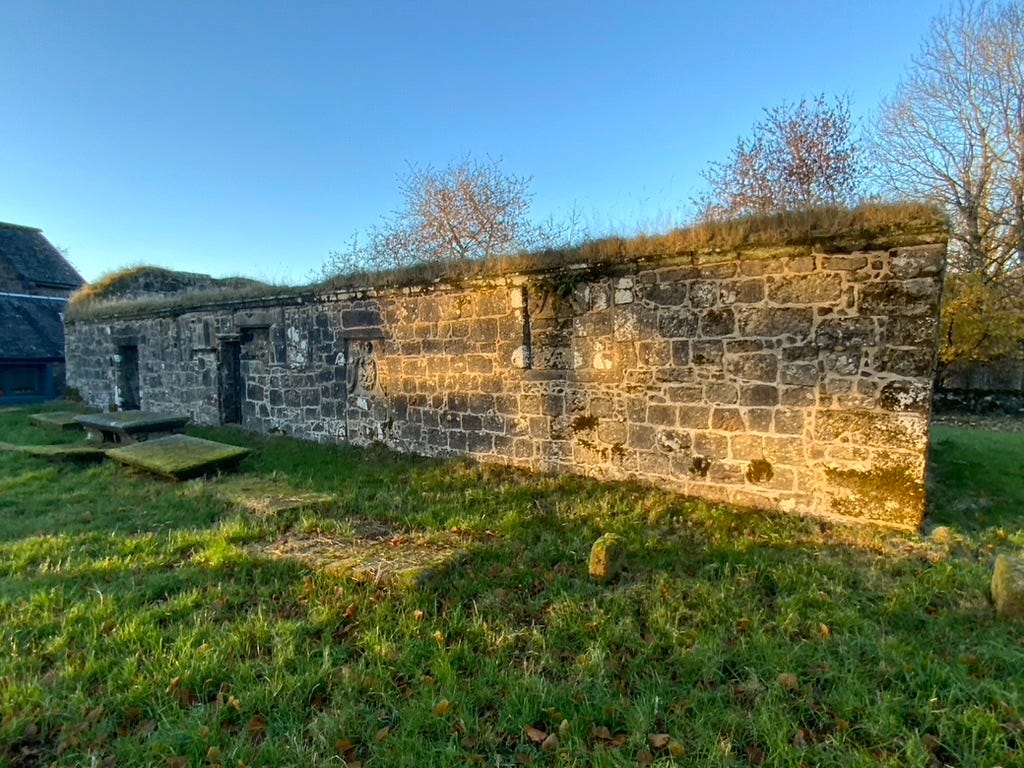
Before coming to the United States, I served a congregation in Scotland called Houston and Killellan Kirk. The old Killellan Kirk dates back to the 1100s and was once a Covenanter church, a place where faith was not always polite or safe.
There were seasons when ministers were expelled by the Crown. Worship was forbidden. And still, people gathered in hills at night, listening for the Word, trusting that God would meet them even when power opposed them.
When I stood within the roofless stone walls of that restored kirk, surrounded by old graves, I wasn’t standing in nostalgia. I was standing among stones layered with courage and fear, faithfulness and cost.
And not all of those stones were triumphant.
Some held stories of punishment.
Some held stories of religious power misused.
One communion vessel from that kirk now rests in a museum because of what unfolded there.
Not every stone in our history is a stone of faithfulness.
Some are stones of warning.
Some are stones of repentance.
Scripture makes room for that honesty.
Israel’s story includes fear, rebellion, failure, and grace. The stones in Joshua do not present a polished past. They testify to a faithful God in the midst of an imperfect people.
If our memory only celebrates heroism and never acknowledges harm, we are not telling the whole truth.
Joshua’s stones are not propaganda.
They are testimony.
Crossing Rivers
There is something else that matters in Joshua 4.
The stones are gathered after the crossing, not before.
Memory here does not prevent movement. It strengthens it.
The Scots who crossed the Atlantic seemed to understand this instinctively. Seeking freedom to worship openly, they left familiar ground and stepped into uncertainty. They carried little, but they carried memory.
Bibles.
Psalms.
Stories of a God who meets people in unlikely places.
Wherever they settled, the Carolinas, Appalachia, the Mississippi Delta, they built churches. Not to recreate Scotland, but to root faith in new soil.
Faith that never crosses rivers does not last.
A Kirkin’, at its best, is not performance or pageantry. It is a visible question:
What do these mean?
And the faithful answer is never, ‘These prove who we are.’
It is always, ‘These remind us who carried us.’
The Stones We Are Leaving
Joshua does more than invite remembrance. It asks us to consider what kind of memory we are leaving behind.
What stones are we placing now?
Stones of fear, or trust?
Stones of exclusion, or welcome?
Stones that trap the next generation in our anxieties, or free them to trust God in their own time?
Because someone will ask.
A child.
A newcomer.
A neighbor quietly searching for hope.
Long after we are gone, the lives we have lived and the choices we have made will still speak.
We always leave stones behind.
The only question is what kind of story they will tell.
So may we place them wisely.
Not to glorify ourselves, but to testify to God’s faithfulness.
Not to protect our reputation, but to tell the truth with humility.
Not to freeze faith in the past, but to carry it forward with courage.
So that when the question comes…
What do these stones mean to you?
We are ready to say:
They remind us that God carried us.
And God will carry you too.
A Blessing for the Journey (Psalm 121)
As you lift your eyes to the hills
to the high places of memory and the valleys yet to be crossed
may you remember where your help comes from.
May the One who made heaven and earth
steady your footing when the ground feels uncertain.
May the Keeper of Israel,
who neither slumbers nor sleeps,
keep watch over your going out and your coming in.
May the sun not overwhelm you by day,
nor the long shadows of night undo your courage.
May the Lord guard your life
your work and your rest,
your remembering and your becoming.
And as you cross whatever river lies before you,
may you know this deep in your bones:
The God who carried your ancestors
is the God who carries you still.
From this time on,
and forevermore.
So be it…Amen.
Thank you.
Beautiful faith reminders …thank you!